Float precision arithmetic
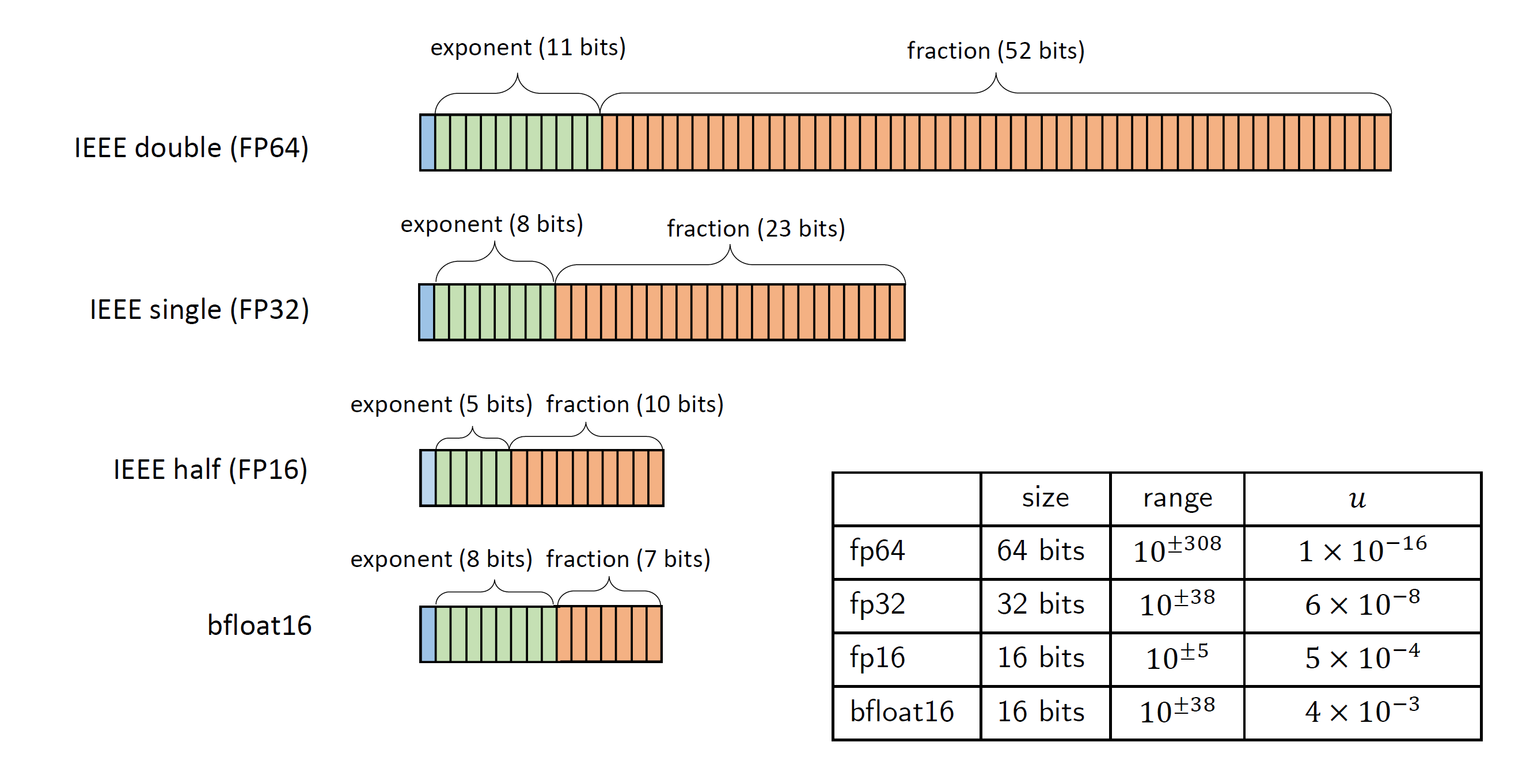
A floating point number systems can be represented by
FaultChop: soft error simulator for floating point arithmetic
Pychop built-in method FaultChop supports the following precision:
Format |
Description |
|---|---|
‘q43’ and ‘fp8-e4m3’ |
NVIDIA quarter precision (4 exponent bits, 3 significand (mantissa) bits) |
‘q52’ and ‘fp8-e5m2’ |
NVIDIA quarter precision (5 exponent bits, 2 significand bits) |
‘b’ and ‘bfloat16’ |
bfloat16 |
‘h’ and ‘half’ and ‘fp16’ |
IEEE half precision (the default) |
‘s’ and ‘single’ and ‘fp32’ |
IEEE single precision |
‘d’ and ‘double’ and ‘fp64’ |
IEEE double precision |
‘c’ and ‘custom’ |
custom format |
Besides, the supported rounding modes include (user can specify it by setting the parameter rmode in terms of the number):
Round to nearest using round to even last bit to break ties (the default).
Round towards plus infinity (round up).
Round towards minus infinity (round down).
Round towards zero.
Stochastic rounding - round to the next larger or next smaller floating-point number with probability proportional to the distance to those floating-point numbers.
Stochastic rounding - round to the next larger or next smaller floating-point number with equal probability.
Subnormal numbers is supported, they are flushed to zero if it not considered (by setting subnormal to 0).
Pychop also supports customized precisions One can also use customized floating point arithmetic by defining precision:
from pychop import customs
prec = customs(t=2, emax=10) # use precision 2 and set maximum exponenet of 10
Second, define parameter customs instead of prec,
from pychop import FaultChop
x = np.random.rand(10000, 10000) # use x = torch.rand(size=(10000, 10000)) for Torch backend
nc = FaultChop(customs=prec, rmode=3)
y = nc(x)
print(y[0, :5])
To print out the unit-roundoff information, simply set verbose=1, use
pyq_f = FaultChop('h', verbose=1)
The result is:
The floating point format is with unit-roundoff of 4.882812e-04 (≈2^-11).
The above example is for bit-level simulation for a small number of values, which is not a high performance implementaion, but rather a tool for illustration.
One can depoy a direct setting to floating point arithmetic (this is very slow for large data, so just do it educational purpose), use:
from pychop import simulate
import numpy as np
x = np.random.rand(100, 100)
si = simulate(base=2, t=11, emax=22, sign=False, subnormal=False, rmode=1)
y = si.rounding(x)
print(y[0, :5])
Note that if emin is not set, then IEEE 754 assumption is used which means emin = 1 - emax
Chop: fast transparent precision emulation for floating point arithmetic and training neural networks
The Chop class enables quantization of floating-point numbers into a custom floating-point format similar to IEEE 754, defined by a specified number of exponent and mantissa bits. This document outlines the usage and examples of this class across four frameworks: PyTorch, NumPy, JAX, and TensorFlow. Each implementation supports six rounding modes:
- 0 or "nearest_odd": Round to nearest value, ties to odd.
- 1 or "nearest": Round to nearest value, ties to even (IEEE 754 default).
- 2 or "plus_inf": Round towards plus infinity (round up).
- 3 or "minus_inf": Round towards minus infinity (round down).
- 4 or "toward_zero": Truncate toward zero (no rounding up).
- 5 or "stoc_prop": Stochastic rounding proportional to the fractional part.
- 6 or "stoc_equal": Stochastic rounding with 50% probability.
This guide offers a practical introduction to the Chop classes, with code examples formatted for clarity and illustrative outputs reflecting the FP16-like behavior
The Chop converts floating-point values into a custom floating-point representation with: - Exponent Bits: Determines the range of representable values. - Mantissa Bits: Determines the precision of the fractional part. - Format: For FP16-like settings (5 exponent bits, 10 mantissa bits), the range is approximately ([-65504, 65504]) with a precision of about (2^{-10} = 0.0009765625) for normal numbers.
The quantization process decomposes the input into sign, exponent, and mantissa components, applies the selected rounding mode to the mantissa, and reconstructs the value, handling special cases like zeros, infinities, and NaNs.
Common parameters
exp_bits: Number of bits for the exponent, defining the dynamic range.
sig_bits: Number of bits for the mantissa, defining the precision.
rmode: String specifying the rounding method, defaulting to “nearest”.
PyTorch version
The PyTorch implementation operates on PyTorch tensors, aligning with IEEE 754 conventions and integrating seamlessly into PyTorch workflows.
Initialization
Create an instance by specifying the number of exponent and mantissa bits, such as 5 and 10 for an FP16-like format.
Quantization
Quantize a tensor by calling the quantization method with the input tensor and an optional rounding mode. The result is a tensor quantized to the custom floating-point format.
Code example:
# Initialize with 5 exponent bits and 10 mantissa bits (FP16-like)
sim = Chop(exp_bits=5, sig_bits=10)
# Input tensor
values = torch.tensor([1.7641, 0.3097, -0.2021, 2.4700, 0.3300])
# Quantize with nearest rounding
result = sim.quantize(values, rmode="nearest")
print(result)
NumPy Version
The NumPy version works with NumPy arrays, providing a general-purpose floating-point quantization tool.
Initialization
Instantiate the simulator with the desired exponent and mantissa bit counts.
Quantization
Apply the quantization method to a NumPy array, optionally specifying a rounding mode, to produce a quantized array.
Code Example:
# Initialize with 5 exponent bits and 10 mantissa bits, half precision
ch = Chop(exp_bits=5, sig_bits=10, rmode="nearest")
# Input array
values = np.array([1.7641, 0.3097, -0.2021, 2.4700, 0.3300])
# Quantize with nearest rounding
result = ch(values)
print(result)
JAX version
The JAX version utilizes JAX arrays and includes JIT compilation for performance, requiring a PRNG key for stochastic rounding modes.
Initialization
Set up the simulator by defining the exponent and mantissa bits.
Quantization
Quantize a JAX array using the quantization method, providing the array, an optional rounding mode, and a PRNG key for stochastic modes. The output is a quantized JAX array.
Code Example:
# Initialize with 5 exponent bits and 10 mantissa bits, half precision
ch = Chop(exp_bits=5, sig_bits=10, rmode="nearest")
# Input array
values = jnp.array([1.7641, 0.3097, -0.2021, 2.4700, 0.3300])
# PRNG key for stochastic modes
key = random.PRNGKey(42)
# Quantize with nearest rounding (no key needed)
result = ch(values)
print(result)
TensorFlow version
The TensorFlow version operates on TensorFlow tensors, wrapping NumPy implementations via tf.numpy_function() with custom gradients for automatic differentiation support (Straight-Through Estimator).
Initialization
Create an instance by specifying the number of exponent and mantissa bits.
Quantization
Quantize a TensorFlow tensor by calling the quantization method. The result is a TensorFlow tensor quantized to the custom floating-point format, with gradient support via STE.
Code Example:
import tensorflow as tf
# Initialize with 5 exponent bits and 10 mantissa bits, half precision
ch = Chop(exp_bits=5, sig_bits=10, rmode="nearest")
# Input tensor
values = tf.constant([1.7641, 0.3097, -0.2021, 2.4700, 0.3300])
# Quantize with nearest rounding
result = ch(values)
print(result)
The examples below demonstrate the quantization of the input values [1.7641, 0.3097, -0.2021, 2.47, 0.33] using a custom FP16-like format (5 exponent bits, 10 mantissa bits) across all rounding modes. Outputs are based on the PyTorch implementation and should be consistent across frameworks, with stochastic modes varying unless seeded (JAX uses PRNG key 42).
Input Values
[1.7641, 0.3097, -0.2021, 2.47, 0.33]
Outputs by Rounding Mode
Nearest:
[1.7637, 0.3098, -0.2020, 2.4707, 0.3301]
Rounds the mantissa to the nearest representable value.
Up:
[1.7646, 0.3101, -0.2019, 2.4727, 0.3303]
Positive values round toward positive infinity, negative values toward negative infinity.
Down:
[1.7637, 0.3096, -0.2021, 2.4707, 0.3298]
Positive values round toward negative infinity, negative values toward positive infinity.
Towards Zero:
[1.7637, 0.3096, -0.2019, 2.4707, 0.3298]
Truncates the mantissa toward zero, reducing magnitude.
Stochastic Equal:
[1.7637, 0.3098, -0.2020, 2.4707, 0.3301] # Example with JAX PRNG key 42
Randomly chooses between floor and ceiling with equal probability (varies across runs).
Stochastic Proportional:
[1.7646, 0.3098, -0.2019, 2.4707, 0.3301] # Example with JAX PRNG key 42
Randomly chooses between floor and ceiling, with probability proportional to the fractional part (varies across runs).
Note
Comparison to Native FP16: The “nearest” mode closely matches PyTorch’s native FP16 quantization (e.g., [1.7637, 0.3098, -0.2020, 2.4707, 0.3301]), validating the implementation.
Stochastic Modes: Outputs for stochastic_equal and stochastic_proportional depend on random number generation, with JAX requiring a PRNG key for reproducibility, unlike PyTorch and NumPy’s internal randomness.
Special Cases: All versions handle zeros, infinities, and NaNs appropriately, preserving IEEE 754-like behavior.